Many pilots refer to the ability to fly as being a balance between having enough time and money, usually with not enough of either. Rarely enough of both. In my case, it's more of a multivariable calculus problem that must account for odd project schedules, quickly changing Montana weather, oh, and of course, the local airport being under construction.
Since I had to fly home from work on a Friday and couldn't get into Billings, it meant I had a reason to be in Bozeman, which meant I had a 'reason' to go fly the Diamond again. The fact that the family would be driving over for a trip to Yellowstone National Park didn't hurt either. So I started watching the weather on Tuesday, and not seeing anything more significant than the typical afternoon thunderstorm forecast (you may as well forecast the sun to rise in Montana) I scheduled a plane for that Friday.
Then it all started to unravel.
First was the email from the flight school saying that I couldn't rent the plane solo without a Mountain Flying course. This was only partially surprising. Though I knew the school had been upping their safety policies, I didn't recall that particular point when I did my BFR two months ago. Nonetheless, I didn't really worry too much about it, and wouldn't mind just scheduling some dual time instead, so I responded with a request to add an instructor to my appointment.
That's where things stood all the way up into Friday. I flew out of Canada and kept an eye on the weather. There was a bit of turbulence on the Airbus into Bozeman and the clouds were starting to build, but it still looked flyable. Until I got on the ground and checked my phone - no instructors were available today. I called back and since I was literally just a five-minute walk from the flight school, I would stop in anyway and see what we could work out.
Good news: my original flight training exempted me from the mountain flying requirement, since I'm familiarized with the area and the aircraft. Bad news: I still can't solo since the school requires a dual flight every 30 days. Worse news: the weather is going downhill fast.
We finally agree on a strategy. If the weather breaks, a single pattern with an instructor will suffice given my history at the school. At least, it will reset the 30-day clock and I can come back another time. So we ponder the clouds, feel the wind, and squint at the radar picture online. Finally, we decide to give it a go. Out to the ramp and a quick preflight underway, then we smell the rain...and the wind picks up. It's not a thunderstorm, but it's enough for a small plane to have a rough time of it. "I don't know," says the instructor. That's enough for me. If the instructor has second thoughts, I don't want any part of it. Back inside we go, and a good choice it was. Eventually, the winds reached 45 knots across the runway. No thanks. I'll wait it out.
And I wasn't the only one. A few other pilots and instructors were playing the same game, hoping for checkrides that depended on lighter winds and no heavy clouds. After almost two hours, things started to look up. The small, isolated showers had moved north and the winds weren't threatening to take the windsocks with them any longer. "Quick! Let's go!"
The instructor and I did a two-man preflight, each on one half of the plane. On the ground frequency, I requested a takoff "with one circuit and a full-stop." "Circuit," says the instructor. "Haven't heard that for a while." "I flew in Australia and Canada..." As before, my radio calls got the attention of the instructor. "What a relief to hear someone who can talk on the radio." Then off we went.
A little wobbly in the wind, but nothing like I would have expected given the gusts just an hour before. Kept the correction into the crosswind all the way around, and though it was a quick circuit, er...pattern, it was good to get it done. My last flight rebuilt some of the confidence I had lost down in Australia, and this one ended in the best way possible: the softest, barely perceptible landing. The instructor commented back in the office, "Textbook doesn't quite capture how good that landing was." Well, I'll take it. I know better that my flying still has rusty spots, but it's nice to have a good day work out as well as this one did.
I may have another chance to fly in the next couple of weeks, but even if not - next stop: Oshkosh!
Tuesday, July 16, 2013

Sunday, May 12, 2013
Unbelievable BFR
This week started out simply enough. I'll be traveling again soon, and I had been busy getting all set for another venture up in Canada. I had toyed with the idea of getting some flying in, but didn't think I'd have the time or good weather for it. Once again, my understanding wife supports me and says, "You should go flying."
Say no more.
The complicating factor is that I'm not current - I need to do a biennial flight review (BFR) to be legal to fly as PIC. Granted, this doesn't keep me from flying with any old instructor, but it was a good opportunity to get it out of the way. As before, I wanted to return to my original flight school and the Diamond DA-20, and I'm very glad I did. Embarrassingly, I had only 8 hours of flying time to show for my last two years, and I somewhat inauspiciously now have two BFRs on the same logbook page. So it goes...
I called the day before to get it scheduled, and drove over through a few rain showers to get to the airport under a very light overcast and calm winds. It would be a nice day as long as we could get the flying in before the afternoon's forecast thunderstorms rolled in.
We spent an hour going over the ground review, covering the airplane, pilot, and flying environment. This means the things that make an airplane legal for flight - airworthiness, inspections, repairs, required systems, and inoperative equipment - along with the pilot's certification and fitness. The "environment" is pretty much everything else - airspace review, flight planning, chart interpretation, weather, traffic patterns, ATC, and briefing resources. The instructor had never heard of my favorite: http://maps.avnwx.com. So we both learned some new stuff.
I preflighted the plane while we waited for fuel. I was back in the routine and could do almost the whole thing without the checklist - using it as a post check rather than a to-do list - just the way it's meant to be. The flight school also had a few new procedures to review - they now require a SPOT GPS receiver in their planes, along with new callsigns for the local airport. And they now chock and gust lock the planes when parked - for some reason we never bothered before.
Now came the best part - flying! Everything came back (if it was ever gone) once I was settled in the cockpit. It's as much a testament to my original instructor as anything else, but I was glad that I didn't fumble too much. We started with a few touch and gos, then hopped over to the practice area. I was on the radio and quicker on the calls than I think the instructor was guessing I would have been given the length of time since my last flights. Even better, after the steep turns and stalls, he couldn't believe I hadn't been flying or studying for the past several months. That's a great confidence booster, even if I still plan on flying with an instructor for the next few hours - especially if I'm in a different airplane again.
Of course, everyone's mileage may vary, but for me it has been very helpful to keep my head in the flying game even if I'm not actually sitting in the cockpit. Even flying commercial airlines allows me to think about what's going on up in front, and watch the airport environment as we taxi in and out of the terminal. I can plan flights I'll never take, check weather briefings every once in a while, and keep up with current events through AOPA and EAA. Contrary to expectations, I don't spend much time with Microsoft Flight Simulator. I toy around with it from time to time, but don't use it for any particular training purposes. I'm worried it might teach me bad habits - and anyway, there's no physical sensation attached to it, so it doesn't help with coordinating turns or looking outside the plane at other real traffic.
Say no more.
The complicating factor is that I'm not current - I need to do a biennial flight review (BFR) to be legal to fly as PIC. Granted, this doesn't keep me from flying with any old instructor, but it was a good opportunity to get it out of the way. As before, I wanted to return to my original flight school and the Diamond DA-20, and I'm very glad I did. Embarrassingly, I had only 8 hours of flying time to show for my last two years, and I somewhat inauspiciously now have two BFRs on the same logbook page. So it goes...
I called the day before to get it scheduled, and drove over through a few rain showers to get to the airport under a very light overcast and calm winds. It would be a nice day as long as we could get the flying in before the afternoon's forecast thunderstorms rolled in.
We spent an hour going over the ground review, covering the airplane, pilot, and flying environment. This means the things that make an airplane legal for flight - airworthiness, inspections, repairs, required systems, and inoperative equipment - along with the pilot's certification and fitness. The "environment" is pretty much everything else - airspace review, flight planning, chart interpretation, weather, traffic patterns, ATC, and briefing resources. The instructor had never heard of my favorite: http://maps.avnwx.com. So we both learned some new stuff.
I preflighted the plane while we waited for fuel. I was back in the routine and could do almost the whole thing without the checklist - using it as a post check rather than a to-do list - just the way it's meant to be. The flight school also had a few new procedures to review - they now require a SPOT GPS receiver in their planes, along with new callsigns for the local airport. And they now chock and gust lock the planes when parked - for some reason we never bothered before.
Now came the best part - flying! Everything came back (if it was ever gone) once I was settled in the cockpit. It's as much a testament to my original instructor as anything else, but I was glad that I didn't fumble too much. We started with a few touch and gos, then hopped over to the practice area. I was on the radio and quicker on the calls than I think the instructor was guessing I would have been given the length of time since my last flights. Even better, after the steep turns and stalls, he couldn't believe I hadn't been flying or studying for the past several months. That's a great confidence booster, even if I still plan on flying with an instructor for the next few hours - especially if I'm in a different airplane again.
Of course, everyone's mileage may vary, but for me it has been very helpful to keep my head in the flying game even if I'm not actually sitting in the cockpit. Even flying commercial airlines allows me to think about what's going on up in front, and watch the airport environment as we taxi in and out of the terminal. I can plan flights I'll never take, check weather briefings every once in a while, and keep up with current events through AOPA and EAA. Contrary to expectations, I don't spend much time with Microsoft Flight Simulator. I toy around with it from time to time, but don't use it for any particular training purposes. I'm worried it might teach me bad habits - and anyway, there's no physical sensation attached to it, so it doesn't help with coordinating turns or looking outside the plane at other real traffic.
Saturday, October 20, 2012
Just a little fly-in'

Just off the coast of Brisbane lies Stradbroke Island. It is one of the several "sand islands" the dot the east coast of Australia, and it is one of the larger ones, along with Moreton Island just to the north.
Like many locales here, it has a small grass airstrip, which in this case is owned and operated by a private aero club. Every month, they hold a little get-together fly-in, and this time invited the school from the mainland to hop over as well.
When I first saw the announcement, I knew I wanted to go. It was advertised as a "ride share" type of flight: split the cost with another student - you fly one way, and the other flies back, with the instructor in the right seat. In my case, since I am neither a student nor can be PIC without an Australian certificate, this would be a purely instructional flight, which meant I could fly (and yes, pay for) the whole time.
But I was still eager to go. This would be a nice trip out over the water, a first time to a grass strip, and it's been 10 months (!) since I was last in the left seat. It was good timing - my work schedule has dropped a bit of its intensity, and I haven't needed to hop on a commercial flight for a few weeks. This will also be the first fly-in that I've actually flown rather than driven to.
We started the day with a quick briefing. This private strip is fairly long and hard-packed, so there wasn't too much concern about it being too soft. But, at 2,800 feet, it still doesn't leave much room for error, and it sits in a small valley. No matter which way the wind blows, there is a fair bit of turbulence. Much of the briefing covered the approach and departure. One interesting tip was to use the rudder more than ailerons for correcting on final approach. The turbulence can cause a wing to stall, and a guy supposedly wrecked several years ago by banking too steeply.
Our flight ended up pretty uneventful. And considering the scales of rust that must be covering my skills, it wasn't as terrible as I was afraid of. We flew a newer Cessna 172, and I really do like it. It's a high wing, but it has as modern a "steam gauge" panel as you can get without one of the fancy glass panels. It also has a smooth-running fuel injected engine. Very nice plane.
The trip stayed low most of the time. We planned for 1,000 feet, but the instructor had to take over for a few seconds to dive us down when I let it get to 1,100 too close to the Brisbane airspace. I didn't get enough muscle into it quick enough. That's a sure sign of not being in tune with the plane - a combination of time and not sticking to a particular make and model long enough to know what forces and control settings will get you what you need.
The approach and landing at Dunwich were a bit bumpy, and though I was cautious of being too high and fast, the instructor commented that we actually seemed a bit low. Overall, it looked pretty good to me, but he might have been wanting to leave a bit more room for the unpredictable winds. In the end, it wasn't a bad landing given the bit of crosswind and a downhill slope.

There were about 40 planes arriving within a half-hour, so it was a busy airstrip for the time being. At one point, we saw three planes on final at the same time. We had a nice breakfast and then our club planes were the first to leave. There were more lessons for the instructors as soon as we got back.
The takeoff was what I expected and had reviewed the night before - with one exception. We started with 10 degrees of flaps, as per the operating handbook. And then we lifted off and stayed in ground effect to accelerate. But we also raised the flaps before climbing out, rather than waiting until we were clear of obstacles. For a non-pilot, this doesn't mean anything. It amounted to a very busy liftoff phase and then a quick climb through the wind shear layer above the hills. Another first-time experience.
 On the way back, I also saw two more things that I've never seen as a pilot - skydivers right in front of me and sea turtles right below me. The turtles were pretty fleeting, as we hummed along at 120 knots and 1,000 feet again. But the parachutes were a bit of a concern, as they appeared about 3 miles directly in front and right at our altitude. They fly out of our airport, and jump on the beach between there and us. Needless to say, we deviated course.
After a bit of a wobbly landing (but pretty close to the threshold), we were back home. A good way to spend real flying time, and a great chance to do some things that I've never done before. Most FBOs balk at taking the rental planes to grass or dirt strips. Around here, that's just the way things are - probably much like the U.S. 30 or 40 years ago.

Tuesday, October 16, 2012
Unlogging Time
Flying is an expensive hobby. And unless you fly professionally, that's pretty much all there is to it. There might be the odd occasion during which you can take the family on an extended cross-country trip, but the stars still have to be perfectly aligned for it to actually be cost effective compared to airline or ground travel.
But that's not why you fly.
So it goes with aviation here in Australia. I'm not officially logging time, but that doesn't mean I can't be a part of the aviation community in other ways. Not only is Australia a big part of aviation history, but the geography is perfect for flying - excellent weather, awesome scenery, water, islands, and rainforests are all the reason you need to fly here.
But for me to fly myself (comfortably and safely) I would want many more hours than I'm able to add. So, as before, we're doing the next best thing:

I've only flown in a helicopter once before, many years ago. Since earning my private pilot certificate, I've toyed with the idea of actually taking some lessons in rotorcraft, but if you think fixed wing is expensive, don't even think about it.
Nonetheless, if you're going to spend money on flying, it may as well be fun. And this time, I was going to have company. Both my wife and my mom (who was vacationing with us) were going to come along. This is a big deal in our family. My mom has been taking flying lessons, though has tapered off with other activities. She's been my passenger on two flights. My wife has also been a passenger, but for someone who is still a bit nervous in light planes, I was surprised - and excited - that she would be coming along.
We took a joy flight with Airwork Helicopters up the nearby coast and then inland toward the Glasshouse Mountains. It was a bit breezy and the visibility was down a bit for some smoke in the air, but we had a great time. As a fixed-wing pilot, it was also a unique experience to hover and watch the airspeed hang in low numbers that normally would lead to a stall.
Then, just a few days ago, another novel experience, courtesy of my wife's initiative and unfailing support of this crazy pastime.


This Tiger Moth is one of over 1,000 still flying in Australia. Antique Airways is the local outfit that provides joy flights in this fabric biplane. Again, I had toyed with the idea, but my wife gives me the push I need to just do it. With flying comes a certain degree of guilt that we're just throwing money into the wind. She gives me the permission to have fun with it. To make sure of it, she even threw in aerobatics!
First off, flying in an open cockpit is not that much different than combining flying with motorcycle riding. It's windy, noisy, and cold, and you spend as much time making sure you don't bend something as you do enjoying the trip. But as a paying piece of cargo, there isn't a whole lot of worrying. I could do just that - enjoy the ride. On top of that, it was my first time in a taildragger (not tailwheel) and on a grass runway.
As sightseeing flights go, we couldn't have had a better day. It had been windy the two days before, and there was some concern it would be a bit bumpy. Not only was it smooth, but the air was crystal clear. We could see for miles up and down the coast.


Then there was the aerobatics.
Near the end of the flight, which up to this point had been from 500-1,000 feet, we climbed up to about 3,000 feet. I was a bit nervous. In the past, even the slight negative-G and unusual attitude practices are a bit uncomfortable (as they should be if you are supposed to be in level flight). Plus, I didn't really know what to expect. Is it going to be like a roller coaster? Like the aerobatics you see on TV? Like the Blue Angels?
No.
At the speeds this plane flies, a full loop might get you to 3 Gs. That would feel like a lot, but not more than a roller coaster, and if you've done as many steep turns as I have (which are just under 2 Gs) it's not much different. Make no mistake, the experience is mind-opening. Don't be afraid of becoming airsick or feeling anything too physically uncomfortable. Even a few minutes of rapidly fluctuating Gs can get tiring though. Mentally? The horizon is not where it's supposed to be and it was tough to stay in pilot mode. I remained the passenger.
We started with two loops, and by the end of the second one, I was already disoriented. It doesn't help that in the front seat of the biplane, there isn't much forward visibility. Nor are there any attitude instruments. You're just watching the world change from ground to sky to ground to sky, right side up, upside down. We supposedly did a cuban-8 or two, but I couldn't tell you they were any different. I know we did a few rolls, but they were all muddled up with the other maneuvers. Some of them could have been part of a half-cuban-8, but I was just along for the ride at that point. We also did a hammerhead, which is fun, but you get a face full of engine exhaust as the plane rotates through its own wash. It's a good thing there wasn't a test at the end.
But at the end of the day, this was an excellent way to experience aerobatic flight for the first time. Low and slow, just a few basic maneuvers. If I ever wanted to do proper aerobatic training in the future, I would feel much more comfortable with it. On top of that, this being Australia, things are much more laid back. I told my wife that in the U.S., I would have needed to wear a parachute. She trumped that by pointing out that I had just taken an aerobatic flight, and neither one of us had signed a single piece of paper for anything. We're going to miss that when we return home.
But that's not why you fly.
So it goes with aviation here in Australia. I'm not officially logging time, but that doesn't mean I can't be a part of the aviation community in other ways. Not only is Australia a big part of aviation history, but the geography is perfect for flying - excellent weather, awesome scenery, water, islands, and rainforests are all the reason you need to fly here.
But for me to fly myself (comfortably and safely) I would want many more hours than I'm able to add. So, as before, we're doing the next best thing:

I've only flown in a helicopter once before, many years ago. Since earning my private pilot certificate, I've toyed with the idea of actually taking some lessons in rotorcraft, but if you think fixed wing is expensive, don't even think about it.
Nonetheless, if you're going to spend money on flying, it may as well be fun. And this time, I was going to have company. Both my wife and my mom (who was vacationing with us) were going to come along. This is a big deal in our family. My mom has been taking flying lessons, though has tapered off with other activities. She's been my passenger on two flights. My wife has also been a passenger, but for someone who is still a bit nervous in light planes, I was surprised - and excited - that she would be coming along.
We took a joy flight with Airwork Helicopters up the nearby coast and then inland toward the Glasshouse Mountains. It was a bit breezy and the visibility was down a bit for some smoke in the air, but we had a great time. As a fixed-wing pilot, it was also a unique experience to hover and watch the airspeed hang in low numbers that normally would lead to a stall.
Then, just a few days ago, another novel experience, courtesy of my wife's initiative and unfailing support of this crazy pastime.


First off, flying in an open cockpit is not that much different than combining flying with motorcycle riding. It's windy, noisy, and cold, and you spend as much time making sure you don't bend something as you do enjoying the trip. But as a paying piece of cargo, there isn't a whole lot of worrying. I could do just that - enjoy the ride. On top of that, it was my first time in a taildragger (not tailwheel) and on a grass runway.
As sightseeing flights go, we couldn't have had a better day. It had been windy the two days before, and there was some concern it would be a bit bumpy. Not only was it smooth, but the air was crystal clear. We could see for miles up and down the coast.


Then there was the aerobatics.
Near the end of the flight, which up to this point had been from 500-1,000 feet, we climbed up to about 3,000 feet. I was a bit nervous. In the past, even the slight negative-G and unusual attitude practices are a bit uncomfortable (as they should be if you are supposed to be in level flight). Plus, I didn't really know what to expect. Is it going to be like a roller coaster? Like the aerobatics you see on TV? Like the Blue Angels?
No.
At the speeds this plane flies, a full loop might get you to 3 Gs. That would feel like a lot, but not more than a roller coaster, and if you've done as many steep turns as I have (which are just under 2 Gs) it's not much different. Make no mistake, the experience is mind-opening. Don't be afraid of becoming airsick or feeling anything too physically uncomfortable. Even a few minutes of rapidly fluctuating Gs can get tiring though. Mentally? The horizon is not where it's supposed to be and it was tough to stay in pilot mode. I remained the passenger.
We started with two loops, and by the end of the second one, I was already disoriented. It doesn't help that in the front seat of the biplane, there isn't much forward visibility. Nor are there any attitude instruments. You're just watching the world change from ground to sky to ground to sky, right side up, upside down. We supposedly did a cuban-8 or two, but I couldn't tell you they were any different. I know we did a few rolls, but they were all muddled up with the other maneuvers. Some of them could have been part of a half-cuban-8, but I was just along for the ride at that point. We also did a hammerhead, which is fun, but you get a face full of engine exhaust as the plane rotates through its own wash. It's a good thing there wasn't a test at the end.
But at the end of the day, this was an excellent way to experience aerobatic flight for the first time. Low and slow, just a few basic maneuvers. If I ever wanted to do proper aerobatic training in the future, I would feel much more comfortable with it. On top of that, this being Australia, things are much more laid back. I told my wife that in the U.S., I would have needed to wear a parachute. She trumped that by pointing out that I had just taken an aerobatic flight, and neither one of us had signed a single piece of paper for anything. We're going to miss that when we return home.
Sunday, April 22, 2012
Paying For It
Flying days are few and far between. As always, time and money are issues, with a regular, distant commute every week making weekend time with the family a primary concern. Though I don't get much PIC time here in Australia, like my work back in North America, I get a regular seat "in the back" on two commercial flights each Monday and Friday.
As before, even though I'm not flying, I'm thinking about it. When the big Embraer 190 or Boeing 737 holds short of the runway, I peek out for traffic on final, mentally switch on the strobes and transponder, double-check the seat belt, and plan for an aborted takeoff. I imagine the pilots in the front advancing the throttle, remember that a jet doesn't need right rudder, and even think of the "V1" and "rotate" call-outs. I watch the flaps come up as the climb is stabilized, and feel the pitch change as we make the turn on course.
Part of the hold up is that it seems excessive to spend a bunch of money on flying myself around the sky (yes, with an instructor, but not really doing anything). We can do airwork, practice navigation, and brush the rust off my landings. For sure, these are all things that I need to do. But in the longer view, what I really want to be able to do is share flight with my family. Yesterday, I took one of my daughters out to a nearby airfield that was having a fly-in. The first question she asks is, "Will we be able to go flying?"
"No, not today."
Thinking to myself, "So, when then?"
I realized that it would take many weeks and several hundred dollars for me to finish obtaining an Australian certificate, then rent a four-seat plane if I want to take more than one kid at a time. It was clear that if I want to share this with the kids, I need to try a different strategy. So it was today.
The local flying club offers scenic flights of the area, and an hour flight is only slightly more expensive than an hour of dual instruction. If I'm only going to fly every four months, I may as well do it this way. At least the kids can come along.
It turned out great. I had scheduled a 182, which would have put me in the right seat with the kids in back. But when we arrived, the club had to shuffle the schedule around. So they gave us two pilots and a ride in a twin-engined Partenavia P68.
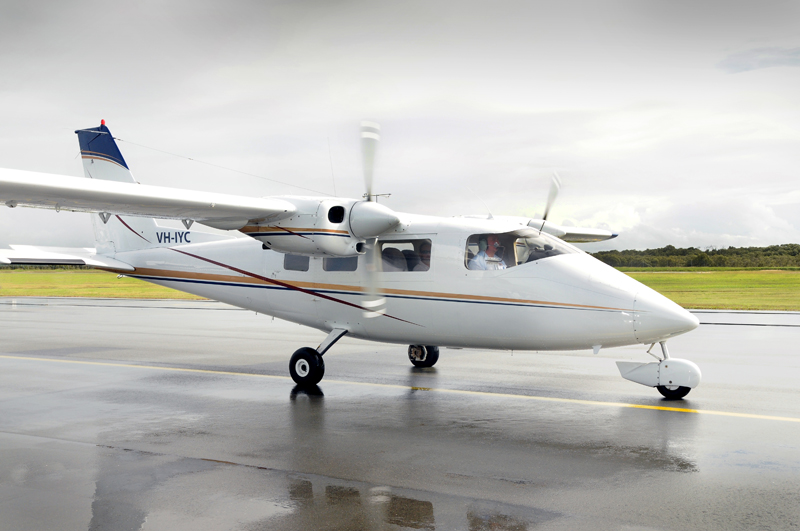
The kids loved it! We flew out over the bay at 1,000 feet, over shipwrecks, boats, the local "sand island", a lighthouse, a hammerhead shark feeding frenzy, and several miles of deserted beaches, with a handful of four-wheel-drive vehicles making their way across the sand.


It was a great way to spend an hour, take a beautiful afternoon flight, and see some of the country - as an unhurried passenger glued to the window. Sure, I can't log it in my own logbook, but the kids get to log a great memory and have another positive experience in the air.
As before, even though I'm not flying, I'm thinking about it. When the big Embraer 190 or Boeing 737 holds short of the runway, I peek out for traffic on final, mentally switch on the strobes and transponder, double-check the seat belt, and plan for an aborted takeoff. I imagine the pilots in the front advancing the throttle, remember that a jet doesn't need right rudder, and even think of the "V1" and "rotate" call-outs. I watch the flaps come up as the climb is stabilized, and feel the pitch change as we make the turn on course.
Part of the hold up is that it seems excessive to spend a bunch of money on flying myself around the sky (yes, with an instructor, but not really doing anything). We can do airwork, practice navigation, and brush the rust off my landings. For sure, these are all things that I need to do. But in the longer view, what I really want to be able to do is share flight with my family. Yesterday, I took one of my daughters out to a nearby airfield that was having a fly-in. The first question she asks is, "Will we be able to go flying?"
"No, not today."
Thinking to myself, "So, when then?"
I realized that it would take many weeks and several hundred dollars for me to finish obtaining an Australian certificate, then rent a four-seat plane if I want to take more than one kid at a time. It was clear that if I want to share this with the kids, I need to try a different strategy. So it was today.
The local flying club offers scenic flights of the area, and an hour flight is only slightly more expensive than an hour of dual instruction. If I'm only going to fly every four months, I may as well do it this way. At least the kids can come along.
It turned out great. I had scheduled a 182, which would have put me in the right seat with the kids in back. But when we arrived, the club had to shuffle the schedule around. So they gave us two pilots and a ride in a twin-engined Partenavia P68.
The kids loved it! We flew out over the bay at 1,000 feet, over shipwrecks, boats, the local "sand island", a lighthouse, a hammerhead shark feeding frenzy, and several miles of deserted beaches, with a handful of four-wheel-drive vehicles making their way across the sand.


It was a great way to spend an hour, take a beautiful afternoon flight, and see some of the country - as an unhurried passenger glued to the window. Sure, I can't log it in my own logbook, but the kids get to log a great memory and have another positive experience in the air.
Subscribe to:
Posts (Atom)
