Thursday, August 26, 2021

"First" solo (in a long time)

 It's always better to reinforce skills with repetition, especially if that can come with no delay between sessions.  Therefore, I did another flight today right after yesterday's review sign off.  To better round-out some of the topics I need to refresh, I planned to take a "mini cross country" around a few area airports.  None of them would be far enough to qualify as official cross country time, but would be enough to practice with the newer avionics, GPS, and try landing at another unfamiliar field.  

I thought I would have enough time to make a complete circuit, but then decided to do a couple of touch-and-goes at the home field before departing to the first stop.  That, combined with a bit of a late start, turned a circuit into an out-and-back trip.  But that was still enough to work on a new (to me) GPS interface and the Aspen avionics suite.  I'm still partial to the traditional six-pack analog instruments, but this was a good time to work with the new systems on a panel similar to this one (but with even fewer dials):

I realized that I have flown three times as many hours with someone else in the cockpit with me (usually an instructor) as solo.  Combined with such a long time out of any cockpit meant that solo flight in an unfamiliar plane in an unfamiliar place was quite unsettling.  Looking back on what was to be a fairly short circuit, it may have been a bit too optimistic even without the time crunch.  

Though it was a relatively calm, clear day, there was just a bit of mountain turbulence which made me keep the speed down to about 90 knots.  Plus, visibility was degrading a bit from the western wildfires which made it more difficult to pick out the airport.  But this gave me a chance to just fly low and slow and take a few moments to just look out the window and enjoy flying again.

My destination was a single, narrow strip with no glideslope lighting (very common at rural fields).  The winds were light and blowing right down the runway.  I made my radio calls, entered the pattern, and landed with only a little bounce at the deserted field.  In addition to the normal concerns, I also took a moment to mentally look for wildlife on the runway and go through the confirmation that I was good to land rather than go around for any reason.  I also picked out a go-around point, which identifies when I've gone too far down the runway before touching down.  If we don't make it before that point - especially on a short runway, we go around.

But not today.  I made the landing and exited to the taxiway to start the takeoff run back at the start of the runway.  I also took a moment to reset the GPS back to the home field and double-check the weather.

Returning back, I did another touch-and-go because I had a few extra minutes, and then landed to wrap up my "first" solo back in the pilot's seat. 

Wednesday, August 25, 2021

Return to flight

 After last week's sessions to knock off the rust, both the CFI and myself thought it wouldn't take much more to be official with the flight review sign off.  Once had agreed that once I could smooth out my landings, he (and I) would be comfortable signing if off and returning me to currency.  While this wouldn't necessarily mean everything was perfect and there wouldn't be room for some additional polish, I could be counted on to get the plane back down safely and make good decisions about go-arounds, engine failures, flap settings, and overall approach stability.

 
When I arrived for the flight, we had both individually thought it would be sufficient to stay in the pattern and just practice those landings.  I also thought it would be good to practice some engine-out landings as well.  On top of that (and adding to the CFI's confidence in my abilities) we had a nice crosswind to practice against.
 
In all, we did ten circuits around the pattern.  On each one, I worked on maintaining a proper wind correction angle and ground track, using surface landmarks to guide my turns.  Happily, every landing was a little better than the one before as I became more accustomed to the proper power and flap settings at each point around the pattern.  Unfortunately however, on the first power-off descent (perhaps by design on the CFI's part) I found myself too far out to make the runway without cheating and adding a bit of power.  On the next few tries, I kept the downwind leg much closer, and managed to finally make a couple of them with no additional power.
 
One of the trickiest parts of a crosswind approach and landing is transitioning from a crab angle into the wind to a wing-low orientation aligned with the runway.  The first couple of tries I was flying the plane down to the runway but pulling the power out at the point I would have in the Diamond.  With the Cessna, it was smoother to keep a bit of power on until transitioning to the landing attitude and then pulling it out as the speed bled off.  
 
By the end, I was able to land consistently and safely and we called it a day as a small thunderstorm started to roll in.  But we were both happy with the quick progress and my ability to execute a safe flight from beginning to end.
 
With that sign off, I became current once again to fly solo (or, with any willing souls) with passengers.  The next step however would be to keep practicing and working on all the aspects of a flight to ensure I stay safe and competent.


Sunday, August 22, 2021

Two Thousand Four Hundred Seventy Three

That's a lot of days.  Over six and a half years.

Like so many pilots who don't fly for work, my own flying took a back seat to the rest of life for far too long.  Without a decent place to rent a plane on short notice and receive some periodic dual time, plus a demanding work schedule taking me outside the U.S. for weeks at a time, flying just couldn't be a priority.  That's not to say I haven't been busy...

Some of the other things that have taken up my time:
  • Teaching two kids how to drive
  • Continued work in Canada and North Carolina
  • Employer closed up shop, so started two businesses, now self-employed
  • Three high school graduations, sending two kids to college and one into the National Guard
  • Several college campus tours, road trips, and camping trips all over the western U.S.
  • Watching a total solar eclipse
  • Countless cross country and track meets, soccer games, mountain bike races, music festivals, and school concerts
  • Supporting wife and daughter Ragnar marathon run and motorcycle license courses
  • Working in Australia again, plus Africa and Peru
  • Taking a motorcycle trip and a safari trip in South Africa
  • Buying three cars, an RV, and two motorcycles
  • Catching two local hot air balloon festivals
  • Riding in a motorcycle parade
  • RV trip to the Oregon coast
  • Visiting and investing in a startup kit aircraft business
  • Attending the Red Bull Air Races
  • Earning a PMP certification
  • Marrying off a daughter, hosting a wedding luncheon
  • Sending kids on school or volunteer trips to Costa Rica, Italy, France, Australia, California
  • Taking a concealed carry firearms course
  • Working in South Carolina and Nevada
  • Long motorcycle trip along the California and Oregon coasts
  • A Caribbean cruise and New Years Eve in Miami
  • Backpacking trips in the Beartooth and Uintah mountains
  • An Eagle Scout Court of Honor
  • Seeing two of our favorite comedians, favorite TV show hosts, and favorite bands live
  • Attending Maker Faire
  • Taking a long RV road trip from California to Oshkosh
  • A pesky pandemic
  • Several major home improvement projects
  • Learning Spanish 
  • And coming soon...a new grandson

As our lives start to transition into the next chapter, all of a sudden flying is possible again.  But it couldn't be as simple as just calling up the old flight school and scheduling some time, could it?

First, I opted to renew my medical through BasicMed.  This is available if you have had at least a third class medical (and not had it revoked or denied) in the previous ten years.  While I could have still been medically eligible for a full third class, the time and availability of an AME made it such that it was simply easier and faster to go the BasicMed route.  

Then, I would need a flight review.  My original school was technically available, but they no longer rent planes if one is not enrolled in a formal course to obtain a rating.  So, even if I could have done the review there, I would still not have a place to rent and stay current.

Plan B entailed calling up a different school about the same distance away at a smaller airport.  They also work with the local college and therefore get busy when school is in session.  But since we're still in the summer months, a plane and a CFI were easy to schedule.  I was able to schedule two flights in the same day to get back up there and knock off the rust.

While I have several hours in a 172, I would have preferred "going home" to the DA-20 given the amount of time away from flying.  Since this new school only has 172s and 152s (besides several larger and more complex models), I opted for the 172 since that would likely be the model I'd rent in the future.  We flew two different planes on Day 1.  

The morning flight was in a model with basic "glass" instrumentation.  Rather than the large G1000 screens which dominate the panel and contain virtually all of the key information, this older plane was retrofitted with a small Aspen display - whose small size belies the high volume of information contained on the screen.
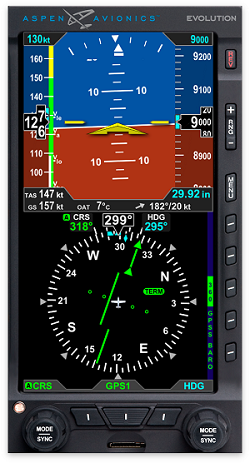

 Rather than spend much time on the ground, we went straight to flying.  I did the preflight, which is so ingrained and routine, I barely needed the checklist even now.  Then we hopped in and I took a bit to get all situated.  The instructor walked me through a few of the instrument steps, but we really only focused on those that would be relevant for today's short flight - setting the altimeter, working the radios, interpreting the dials, etc.  As I went through all the steps of getting the weather, picking a runway, listening to other traffic, and going through the rest of the pre-takeoff steps, I said out loud almost everything and what I was thinking about.  This helps any instructor know what's going on in your head and why you might be doing something in a particular way.

Then it was time for takeoff!

This is a small airport with no control tower and just a single runway.  So we listened and looked for traffic, then opened the throttle and accelerated down the runway.  Most everything came back from my memory in an instant.  Keep your hand on the throttle, let the plane accelerate to rotation speed, gently pull back on the yoke, continue to accelerate in ground effect and gradually let the nose point at the right angle to climb out at Vy (the best rate of climb airspeed).

The instructor wanted to focus on slow flight and stalls.  This isn't too surprising, since that's where many students (and licensed pilots) have trouble and one of the first things to degrade after not flying for a while.  But in my case, this wasn't too bad.  I struggled a bit to find the right combination of pitch angle and power to achieve the right speed without losing altitude, but after a couple of tries got it good enough (not perfect by any means).  Rather than the instructor just telling me the right combination, he let me sort it out and kind of wallow through the air for a bit to see how I did.  Stalls were actually pretty uneventful.  You don't have to be super-precise with any particular item, other than keeping the wings level and staying on heading.  Both power-off and power-on stalls were pretty decent, but again could use a little polish.

The instructor threw in the not-unexpected practice engine failure, and I immediately went to tunnel vision trying to find a place to land.  The main problem I had here was focusing on a place that was too close and then needing to lose altitude and energy to make a landing.  But I neglected to do the normal "flow" of the emergency checklist to practice checking fuel and engine to attempt a restart.  Also, I kept needing to change my target landing spot.  I should have used slips, turns, or even flaps to start descending.

The afternoon flight was similar to the morning, but in a plane with slightly less power.  That meant that as we climbed out in this warm, high altitude environment, we pretty much stopped at about 7,000 feet altitude.  The instructor mentioned we may have been caught in a downward-flowing mountain wave, and this was completely foreign to me.  While I've read about them, it didn't occur to me that we could be in one, and looking back it would have been good to talk about the exit strategy if I was encountering rising terrain I couldn't outclimb (in this case we had plenty of altitude). 

We made a total of seven landings, three in the morning and four in the afternoon.  None of them are what I would call great, but they were all within acceptable margins of safety, on the centerline, and allowed for a relatively smooth touchdown.  But on one end of the spectrum, I was far too fast on final, mis-remembering the approach speed (which I had been remembering all the landings before...??).  On the other end, I had one picture-perfect approach which came apart about three seconds before touchdown due to a downdraft or windshear and I had to add a bunch of power before floating down the runway again.  

The big takeaways here, for patterns and landings - watch the speeds, and put in flaps at the same point of the pattern each time.  I also need to watch the left crosswinds since I kept overshooting the base to final turn, which was made worse due to flying a high-wing plane and not being able to see the runway creeping up on me.

Day 2 was a non-flying day due to low clouds and rain, so we did the ground portion of the flight review.  This was also uneventful and I only had to look up a couple of technical items.

Now on the schedule is another flight or two next week to keep working on the basics until I can be fully signed off for solo flight again,

Sunday, November 9, 2014

One More for the Road

Winter is coming and so will my trips to Canada.  Less time at home and cruddy weather meant I wanted to get one last short flight in today.  Luckily the weather system at hand is a slow-moving front at the center of a low pressure zone.  Lots of overcast and cool temperatures, but for now the winds were light, and a fairly consistent direction.  Good enough day for a quick flight around the neighborhood.

I took a passenger this time and we stayed low, just about 1,000 feet above the ground to stay out of the bumpy winds up higher.  But a great altitude for just putting around and visiting the Billings airport for a couple of touch-and-gos.

The entire country experiencing fair fall
weather except for our Northern Rockies
Like the past few flights, I concentrated on the pattern, approach, and landing.  Fly pattern at 90 knots, then reduce power abeam the touchdown point (not the end of the runway), maintain 80 knots to the base leg, then more flaps and reduce to 70 knots.  Keep 70 all the way down final and save the last notch of flaps for the last 50 feet.  Let airspeed drop to 60 over the threshold and power to idle.  Then a nice, smooth flare to touchdown.  Sounds so simple.

It all clicked again today, and though we kept it short to stay out of the weather, a great flight before what will likely be another dry spell for a while.

The cold - it's coming.


Sunday, October 26, 2014

Weekend Triple Play


Based on my last flight’s debrief, I tried to get more time in sooner rather than later.  Last weekend didn’t work out, but I was able to get in this Saturday.  Again based on my last experience, I wasn’t expecting anything too great.  Figuring I needed a lot of work to get back in the groove, I focused on a few key areas knowing I would be back in a 172:
  • Being established in the pattern and timing power and trim changes for landing
  • Keeping the nose up in the turn
  • Recalling the sight picture for landing
So I did my homework.  The plane would be a newer model 172 – in fact one that I had flown before – so I downloaded the POH to study speeds and procedures.  I also found an excellent resource specifically for late-model 172s published by ATP.  Since they are a well-established academy with standardized procedures and a fleet of 172s, they have put together a manual just for that specific plane.  Rather than the more general handbook advice you might find elsewhere, this one has specifics like power and flap settings for the pattern.  Reviewing it changed everything.

The plan of the day was to obtain a rental checkout.  At this school, the requirement is to perform three touch-and-gos with the instructor.  But I wanted more to get me where I wanted to be.  So we set it up to be a similar set of airwork exercises as last time – some slow flight, stalls, and steep turns as well as pattern work.

Happily, the weather was clear and the air was smooth.  I’m sure it helped, but compared to the last flight, this was completely different.  The review of procedures and the short time between flights made for a totally opposite outcome.  Stalls were crisp, steep turns were right on, and I managed airspeed in a way I don’t think I’ve ever been able to do.  Everything came back together.

So now the test – how were my landings?  Let’s put in this way – there were just a couple of points to work on after the first try.  Get the sight picture right and keep the speed up.  Using the ATP manual as a guide sets up a slower approach than the school here likes to have.  It essentially was a short-field approach – completely OK but removing some of the margin of error, and an easy fix.

Now that I had my trim adjustments and power settings more dialed in, adding 10 knots to the approach speed was easy.  On the next circuit, suddenly the sight picture snapped into place as well.  This was turning out great, and the last landing was even better.  I was very happy with the outcome – to the point that I wasn’t ready to stop.

But we did; the instructor had another student.

However, this plane was still available for another few hours.  Enough time to run home, pick up any interested passengers, and take another flight.

An hour’s tour around the area and, though the winds had picked up a bit, another great landing.

And?  The plane was open on Sunday as well.  Would the wife like to take a flight as well?  Yes, she would.
A very nice, cool morning awaited.  A cold front was on its way in, and I knew we didn’t want to be in the winds with a fairly new passenger.  But the morning looked good and we got out and back before it shifted to a gusty crosswind.  

All in all, three flights in two days.  Granted they were short, but the reinforcement of skills was and continues to be very important.  I’m hopeful this is a turning point that allows me to fly a little more often than I’ve managed in the recent past.  If so, there’s no doubt my flying will only get better.