It is spring, isn't it? You wouldn't know it around here. Snow last week, and more tomorrow. But in between, it's been fairly nice. The winds pick up every day, so I keep an eye on those, and today seemed to be a good day to try out a new set of wings.
After a few weeks of reading up on the G1000 (the Garmin "Glass Cockpit"), I scheduled some time in the school's DA-40. This is the four-seat, bigger cousin of the DA-20 that I have flown up until now. Not only that, but it has a constant-speed propeller (yet another level of complexity). It is also an extra $50 an hour, but who's counting?
The idea behind the glass cockpit is taking out all of the dials and needles that you may be familiar with (basically any general aviation panel before Y2K) and replacing them with two large, flat-panel displays more like an airliner or fighter jet. All of the same information is there, albeit in vastly different forms. And there are plenty of new features, with literally several new "bells and whistles". Every time you disconnect the autopilot or deviate from a set altitude, the plane will ding, bong, and beep to let you know.
The biggest hurdle, especially after having an instrument scan burned into your brain during primary training, is looking at different parts of the panel and reading scrolling numbers rather than spinning dials. For me, this was a bit difficult, and I kept finding my eyes drawn to the points in space that I would expect to see an altimeter or airspeed indicator. Even some of the switches (especially the flaps) are in a different place, and it's a reach - with eyes inside the cockpit - to find the right spot.
The constant-speed prop is also a new idea for me. It means another lever to fiddle with during changes in the flight profile (climbing, leveling off, and descending). The trick is to know what power and prop settings will get you what you want, putting them there, and letting the plane settle into equilibrium - which takes a few extra seconds compared to the smaller craft.
The lesson today was the first to be checked out to solo this particular plane. We did some steep turns (which came out quite well, thank you), slow flight, and stalls. In all, this is a very smooth plane, and it responds very well to control inputs, both on the ground and in the air. I really enjoyed the flight, but it will take much more practice to be as comfortable with it as the DA-20.
As an added bonus, the light winds that had been the rule for the day decided to give way to a 20-knot surface crosswind that made takeoff interesting and landing impossible. I had an unfamiliar plane with unfamiliar handling, sight pictures, sounds, and feel - and I had left rudder to the floor during the roundout. It wasn't coming together, and I had to go around for a landing on the crosswind runway.
Not bad for the frequency of my flying lately.
Friday, April 4, 2008

Saturday, March 22, 2008
First Passengers
The forecast was a bit sketchy, with some clouds and wind anticipated for the afternoon. I kept an obsessive watch on the satellite picture and the nearby METAR's to be sure that my first passenger flights would be good experiences.
The weather really could not have been much better. Aside from a few gusty surface winds at my destination, the three total flights (my father-in-law cross-country one way, my brother-in-law's short hop over the local patch, and my mom's trip back to the home base) turned out better than expected.
It was a beautiful day, with scattered snow showers masking some distant mountain peaks, but clear skies and 15-20 knot winds aloft. I even got to fly the school's brand new (only 190 hours-old) DA-20, just recently released from dual-only flight. Each cross-country was only about 60 miles, and the local trip "around town" was only about 20 minutes, but just perfect for first flights. My mom was the only one that has had general aviation experience, at least in the cockpit (and she's also currently in ground school). My father-in-law went skydiving once, but he apparently was a little too preoccupied to pay much attention to the aircraft aspect of the trip.
All had a great day, and with two more hours of cross-country time, it was worthwhile for me as well. I even impressed myself with some quick rudder action in a gusty crosswind for a glass-smooth touchdown. I was proud to show off my new skills, and it was neat to have someone on hand to take some pictures for once.
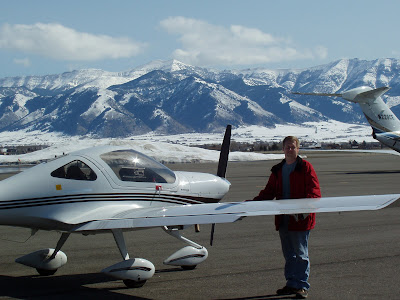
Preflight photo op
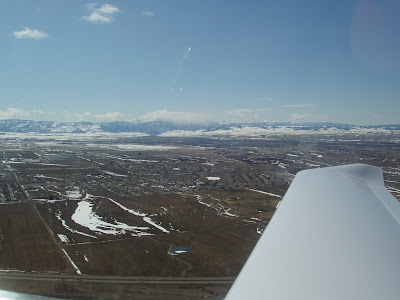
Looking out over town
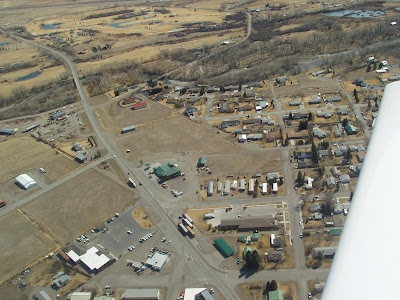
You can see my house in this shot
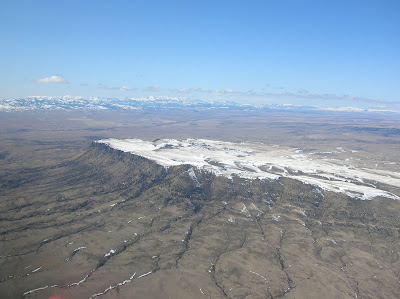
On the way back
The weather really could not have been much better. Aside from a few gusty surface winds at my destination, the three total flights (my father-in-law cross-country one way, my brother-in-law's short hop over the local patch, and my mom's trip back to the home base) turned out better than expected.
It was a beautiful day, with scattered snow showers masking some distant mountain peaks, but clear skies and 15-20 knot winds aloft. I even got to fly the school's brand new (only 190 hours-old) DA-20, just recently released from dual-only flight. Each cross-country was only about 60 miles, and the local trip "around town" was only about 20 minutes, but just perfect for first flights. My mom was the only one that has had general aviation experience, at least in the cockpit (and she's also currently in ground school). My father-in-law went skydiving once, but he apparently was a little too preoccupied to pay much attention to the aircraft aspect of the trip.
All had a great day, and with two more hours of cross-country time, it was worthwhile for me as well. I even impressed myself with some quick rudder action in a gusty crosswind for a glass-smooth touchdown. I was proud to show off my new skills, and it was neat to have someone on hand to take some pictures for once.
Preflight photo op
Looking out over town
You can see my house in this shot
On the way back
Monday, March 10, 2008
Finally - Some Flight Time
About time. After the fiasco last time, I was definitely ready to get back into the air and keep my skills up. Since I eventually want to get an instrument rating, I've been working on planning mostly cross-country flights to work on navigation. It's not really instrument training, but it's work to polish up the flying and tighten the tolerances.
Today's flight was the same one that I had planned for last time. This time, it went off without a hitch...well, maybe just one. The winds were a bit much and I never made up my time flying into a headwind, arriving back home a bit late. But if that's the worst of it, I'm happy.
The trip was just two legs, with a VOR in the middle. I don't let the apparent simplicity of the navigation to make for a "routine" flight though. I monitored my progress, noted times at checkpoints, cross-checked my VOR with my GPS with my chart, and paid close attention to my heading and course. I also went through the radio frequencies of the fields I passed and kept in the habit of checking my engine instruments every few minutes.
Arriving in the vicinity of my destination (an uncontrolled field) I made the radio calls and kept an eye on a departing flight. Overflying the field, I checked the wind and then went out wide, descended to the pattern, and came in for a good landing. After a short stop to reverse the GPS flightplan and double-check my times, it was back into the air for the trip back.
It was a good exercise to arrive at an unfamiliar field, and I tried to maintain my altitude a bit better than I usually do. It still needs work, but it was a good post-checkride "lesson".
Thursday, March 6, 2008
Right Rudder?
It's been nearly three weeks since my checkride, and I haven't flown once. Today, the weather was good enough to give it a shot.
I planned to fly a short cross-country to stay current and start building up those hours in anticipation of a future instrument rating. The weather was a bit iffy, with some winds and scattered clouds, but I studied all the information and obtained a briefing, and I felt good to go. Even so, I had an alternate plan in mind should the clouds come in faster than forecast. Turns out, I needed to completely deviate from my plan when the plane decided to act up....on the ground.
I went through my startup and got all my things organized, even putting in my short hop to the GPS flight plan. I taxied down to the end of the runway and pulled off to do my runup. As I turned the plane around, I felt and heard a POP and the right brake pedal went "to the floor".
As an aside, the Diamond DA-20 has no steerable nosewheel. It is freely castering and simply reacts to the turning caused by applying one or the other of the main wheel brakes. This means that with no brake on the right side, I could not technically turn right. Fortunately, this plane also has a sizable rudder and is light enough that even a normal taxi speed provides enough rudder authority to maintain direction.
I immediately knew that my "flight" was over, and as I fiddled with the pedals to confirm that just one side was affected, I was on the radio requesting a taxi back and explaining my situation so as not to be put in any tight spots. The controller was very understanding and asked if I needed him to call over to the flight school to have someone come out to help. I said, "Negative" and he cleared me to taxi back.
There was another plane waiting to taxi to takeoff, and he was informed that I was moving slow, which caused no problems. As I taxied, I carefully experimented to see just how marginal my directional control was. It didn't seem too bad, but I knew I would have to slow down as I got up to the ramp area and would exit the taxiway toward lots of (expensive) parked aircraft. The waiting plane was cleared to taxi after I would clear the taxiway, and I was cleared (again) to continue on my way. I "rogered" and started to turn off the taxiway.
As I slowed down, it didn't take long for my lack of right-turning ability to catch up with me. At still a fairly normal taxi speed for the area, I had to decide what was going to happen next. The throttle already at idle, it was either speed up a bit and get the rudder into the mix again, or pull the mixture, cut the engine, and use just left brake to come to a stop. It quickly became apparent that more speed was definitely not a good thing at this point. I also noticed out of the corner of my eye that a couple of folks from the flight school were walking out toward me, apparently aware of my predicament.
The slow speed resulted in a nearly 90-degree turn to the left as the engine and wheels stopped turning at about the same time. I paused and told the ground controller that "We'll have to push it off." I was stopped just inside the dividing line between the ramp (a "non-movement" area) and the taxiway (a "movement" area). Movement areas require controller clearance to enter or operate within (whether you are a plane, vehicle, or pedestrian). Since I still technically had a clearance to "taxi" back to the hangar, it felt reasonable that we would simply do so. I finished completely shutting down the systems, including the radio, and hopped out as one of the school staff, a student from the school, and a lineman from next-door got to the plane.
We began pulling/pushing the plane up the ramp, and as we did so, we were intercepted by one of the airport authorities who was very upset that we had created a "pedestrian incursion" in a movement area without controller clearance. As it turned out, according to the CFI that came out, the controller had called the school anyway, unbeknownst to me, and despite my original answer, and they had come out at his request. Since I was still a few hundred feet from the hangar, it felt good to see some help coming over.
Anyway, I have a feeling this little incident might not be over, but I don't see much that I could have done differently, other than just sit there and wait for help. I felt that the controller knew what was going on and that once I shut the plane down, I would not have a radio, but there might be some special procedure for a case like this that I'm unaware of. If so, I will bet that I will find out all about it in the near future, in very great detail.
Saturday, February 16, 2008
The Big Day, Part 2
The details of the maneuvers clearly aren't all that interesting. If you know the practical test standards, you already know what to expect and if you know that I passed (I did), then you know what I had to do. The sequence went something like this:
Climb on course on the first leg of our fictional cross-country
Look for landmarks and compare them with the chart
Navigate based on the VOR and based on GPS
Level off at desired altitude
Oops, you flew into a cloud. Put on the hood and get us out of here.
Pretend to call the tower and follow their directions to get us back to the field
You are in an unusual attitude, get us out
Okay, hood off, get us to the practice area for slow flight
"I want that stall horn screaming nice and loud."
Some slow turns, then a power-on stall, a power-off stall, a turning stall, and then another turning stall
Show me some steep turns (Yay!)
Oops, your engine failed, get us down
Okay, your engine's back; stay low and do a turn around a point
"What do these buttons do?" (While I'm focused on the turn in a 20-knot wind)
Let's head back in for some touch-and-go's
Show me a normal landing, followed by a soft-field takeoff
Show me a soft-field landing with a slip
Do short-field landing, with a stop on the runway, followed by a short-field takeoff
Land on that spot right there
No, that other spot....
Okay, let's go in. Good job.
That may seem like a short list, and it felt like it was only as long as you probably took to read it. When it was all done, there were a few tips that he had (not surprising for a 50-hour student), but nothing that was a deal-killer. So, I'm now qualified to lead others into the great beyond...no, wait, that's not what I meant. I mean I'm now certified to demonstrate hours of boredom punctuated by moments of sheer terror. Yeah, that's more like it.
See you up there.
Subscribe to:
Posts (Atom)
