 Today's flight was much more uneventful than last time, due to the cooler morning air, the lack of thermals, the lack of any big winds, and a nice overcast to keep things generally cooler in the cockpit as well.
That made it a nice introduction to ground reference maneuvers, although it didn't really provide a good environment to prepare for the tested skills. So, we didn't spend too much time on them, and as you can see from the tracks, it was pretty easy to turn around a point, although the timing on my S-turns could be a bit better. (I didn't quite get perpendicular to the road by the time I had to roll from one direction to the other). We will be coming back to these when there is enough wind to keep it interesting.
So instead, we concentrated on pattern work, low approaches, a couple of touch and go's, and a landing. In the midst of all that (a total of 7 approaches), we had other traffic, a right-hand pattern, a wind (and runway) change, a right 360 for spacing, and a quick turnaround and short base. Oh, and a near-collision with two small birds on one of the climb-outs, just for good measure.
All in all, the hardest part of this is the low approach. This is a "maneuver" where you come down to the runway as if to land, but then add just enough power to float about 10 feet over the runway at minimum speed. It's an exercise designed to accustom the student to low altitudes, looking all the way down the runway at landing, correct for crosswinds while tracking down the centerline. Suffice to say, it's hard to do, but worth it. It doesn't feel right to be that low and not be on the ground, and the cross-control required for a crosswind is a challenge as well.
The next lesson introduces emergency procedures, so it will be even more of a challenge to start making the past lessons second-nature while dealing with engine failures and such.
Just as in many aspects of life, miscommunications while flying can lead to confusion, delay, and dangerous situations. In the midst of a critical maneuver, miscommunication can lead to immediate disaster if not remedied. Yesterday's flight had a minor dose of miscommunication, in the form of a command from the instructor that I was not familiar with. While it did not affect the immediate safety of the flight, it occurred during the second low approach and led to a tense few seconds.
The intent of the second go around was a touch and go. But immediately prior, we were doing another low approach, as we had on the first run. Whether I 'remembered' what we were supposed to be doing or not, I was definitely concentrating on maintaining the low altitude right over the runway rather than anticipating the touch and go (which was my first).
In any event, as we were 3/4 of the way down the runway or so, T.I. decided it was time to touch down and commanded "throttle out", meaning to idle. This was a term that I had never heard before, either in past flights or on the ground. He could have said "idle power", "cut power", "pull throttle", "pull power", or a number of other things that would have made sense to me. As it was, my mind was trying to grasp the meaning as we were barely 10 feet over the runway. His commands of "out!" got louder and more frequent the farther we went for about 4 seconds. I remember consciously thinking that "out" might mean to climb out, and that at least, the worst thing that we could do was to get higher.
So, as my hand froze on the throttle, my brain scrambled to put meaning to this word, and we wallowed closer and closer to the end of the runway, I (probably unconsciously) decided that the best move was to add power and climb out. This was when the command changed to "IDLE!", and I said "Oh, I didn't know what that meant." Power back to idle, and we managed a quick touch and go that had plenty of room to spare. On the climb out, we had a little talk about how T.I. would make sure to clarify new terms. I didn't give it much thought at the time, but it highlighted an important facet of flying.
While my brain struggled for comprehension, I couldn't speak and I couldn't do much else other than the physical control of the airplane that I had just recently learned. I wouldn't say it was panic, but I was definitely frozen as far as the task was concerned. I still was keeping an eye on the far side of the runway, and if we had actually been in danger, I was consciously prepared to gun the engine and climb. It was clear, though, that whatever conscious thoughts I was processing were probably vastly outnumbered by the rapid computations of trying to interpret one little three-letter word. That computing power taxed my brain's remaining resources, and left little room for the ability to even ask a question or simply say "what?"
That 4 or 5 seconds was a vivid reminder that miscommunication needs to be cleared up immediately. It is also a reminder that if the act of controlling the airplane is not learned to the point of being able to do it subconsciously, a real emergency can quickly overpower the thoughts you need to do it. That is where a simple "freeze up" can turn to panic and lead to disaster.

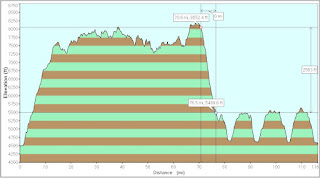 After a 10-day hiatus, I was back in the air again today. The afternoon was the only time available and so I had to contend with pretty choppy thermals while practicing steep turns. These are banking turns over 30 degrees, and in this case, were supposed to be 45 degrees. Unfortunately, that ended up being more difficult than I anticipated, especially after doing a few slow ones last time. When all was said and done, my instructor and I decided to relax the altitude monitoring and just focus on maintaining speed and rolling out on the right heading. On that count, things weren't too bad.
We also did some stalls, which I tried to complete a bit more crisp than last time, and I did for the most part. In the warm air, the bottom dropped out on one of them, and we actually nosed down more severely than typical for this plane (although still nowhere near a Cessna 150). Nevertheless, recovery was much smoother, especially from a rudder standpoint. This plane really likes to turn left and I was definitely making an effort to remember plenty of right rudder.
Upon deciding to return to the field, we had to lose about 3000 feet of altitude in about 6 miles. Not a bad task, but it would have felt uncomfortable to someone not accustomed to a small plane's motion. I think we were descending at about 1500 feet per minute or so. It was a good exercise to make sure I could keep the speed under control, which I did well, according to the instructor. Our ground speed during this was about 140 mph.
Then it was time for a little pattern work, slow flight over the runway (low approach), a touch and go, and then landing. Luckily, the bouncy air wasn't as bad right near the field, except for the little thermal pockets and a touch of crosswind just over the runway. The absolute key to success here is only glancing at the near end of the runway while keeping most of your gaze out to the horizon and the far end. I had a bit of trouble staying as low as my instructor wanted, but the second time around was better. Then, I had the controls all the way to landing on the third go-around.
All in all, this was a bit of a stressful flight due to the thermals, but not for the reasons I would have thought. I usually don't like turbulence for the simple fact that it is uncomfortable. This time, though, I think I was concentrating so much on simply flying the plane that it was more of a nuisance and didn't really bother me physically. Good to know. And it's also a good thing to be able to fly in it, just in case my checkride ends up being on a hot day.
 Today, we worked on slow flight and stalls. With all of the flying that I have done, I am most familiar and comfortable with taking off, going somewhere, and then landing. The various maneuvers that go along with this are pretty simple, and they come the easiest to me (basic turns, holding heading, working the throttle, maintaining airspeed). In a normal flight, you don't experience the types of attitudes, sounds, and feel that go along with stalls and other exercises required for the license.
So, with this in mind, combined with what I have heard from other pilots about stalls (and spins), today I was a bit more anxious than the first lesson. My takeoff was meandering down the runway, I was too light on the controls, and I just had that sinking feeling that something was going to happen that I wasn't going to like. It was harder to concentrate on the procedures, although I am pretty much officially in charge of the radio communication (even though I miss a detail now and then). I definitely feel like many others, who face a barrage of information and struggle to maintain a good scan of the instruments (especially the engine side of the panel).
Today's flight, then, was a bit of practice with the slow, shallow banks, which I can handle pretty well. Then came a power-on stall, which is done by applying full power with the takeoff flaps deployed, simulating a too-steep climb out after takeoff. The plane's nose comes up, the stall horn is buzzing (not the electric kind, either, but the "kazoo" that just uses the suction on the wing).
The short version of events is that I am one of the 98% who just can't keep enough right rudder in to offset the left-turning tendencies. Some more reading and mentally connecting the rudder to the bank of the wings may help in the future.
 Today, we learned about traffic avoidance....but more on that later.
First, we had a bit of ground instruction regarding the pattern and signs around the field. A little bit of talk about left-turning tendencies and slow flight, the main focus of today's lesson.
The plane was fueled up during our office time, and I had the preflight all to myself while the instructor took care of some admin. stuff. This was a different plane, but was covered in bugs like the other one. The weather today was concerning me, since there was a broken layer and some light sprinkles, but it was up at 12,000 and VFR for the practice area.
Again, I handled the radios, this time remembering to inform the controller that I had the proper ATIS weather information. I handled the taxiing much better as well, not repeating my prior imitation of an inebriated airline pilot. This plane has a castering nosewheel, so taxiing is done with power and brakes. When setting up for the run-up, the plane should be allowed to coast straight so as not to load the nose in a turning condition.
Although there were about 6 planes in the air, including a glider, as I arrived at the field, there was no one else around during takeoff. Takeoff itself also went much better, without a big yaw to the left as I did last time. I tried a mental technique of pressing the right rudder like a car's gas pedal (accelerating down the runway). It worked too well, and I yawed a bit to the right, but not badly. The DA-20 lifts off at about 45 knots, so it doesn't take long to get up in the air.
Climbout was smooth and we went a bit higher than last time to have room for slow flight and descending turns, to prepare for pattern work. At altitude, we did two clearing turns and then proceeded into two level 360's. They sure seemed fine when I did them (at least the altitude was good), but looking at the GPS track, I can see I'll need some work on ground reference (although that wasn't a concern today).
Then we slowed down and put out full flaps to practice rolling on a heading as we did before. This time, though, the slow speed makes everything "mushy" and exaggerated. It was hard enough before, but this time I had to keep arresting the big yaws I was creating. While still slow, we did some 90 degree descending turns. These were pretty uneventful, except for an inadvertent stall due to a wind gust. Then another climb, level off, and then slow down with flaps again. We did another descending turn and then a descending 180. Back up, then power to idle to practice a gliding, descending turn as would be needed in an emergency. The DA-20 has a gliding ratio of about 11:1.
Finally, we added power, climbed up a bit and leveled off for the inbound leg to the field. About this time, we called the tower, and heard the clearance for the school's other DA-20 to take off. As we were looking for it where it was "supposed to be", it magically appeared in front of us and I made a little bank to make sure we stayed clear. He probably saw us first (we were looking toward the sun) since he also steered clear. Pretty much a non-event, but still added a bit of excitement.
I flew most of the pattern from downwind to base, to final. I held final pretty far down (for a second-timer) and the instructor took the landing at about 300 feet AGL. Then it was a taxi back and time to go to work again.
 Today's flight was much more uneventful than last time, due to the cooler morning air, the lack of thermals, the lack of any big winds, and a nice overcast to keep things generally cooler in the cockpit as well.


